
“Dress in light and shadow” Raffaele Ingegno
Raffaele Ingegno talks about why you need to experiment and why it is worth drawing inspiration from the work of other photographers, as well as about the behind-the-scenes process of creating the unique “Dress in light and shadow” project. My inspiration was the work of George […]
Raffaele Ingegno talks about why you need to experiment and why it is worth drawing inspiration from the work of other photographers, as well as about the behind-the-scenes process of creating the unique “Dress in light and shadow” project.
My inspiration was the work of George Mayer, an outstanding Russian photographer born in 1985, who created beautiful series of photographs by carrying out many experiments with double exposure, mirrors, colors, shadows, and geometric patterns. He mainly photographed people, drawing inspiration from the shadows of their silhouettes, often combining them with luminous geometric shapes.
I wanted to experiment with this idea myself in order to improve my skills and my ability to precisely use cuts of light and projected shadows. This resulted in a photograph of Chiara Bianchino, dressed in an elegant black dress.
I did not want to use a projector, because the idea seemed too obvious to me. There are many photos created with a projector, and I did not want to repeat the same pattern. It is possible that in the future I will want to use this technique to create something new, but this time I focused only on the interplay of light and shadow.
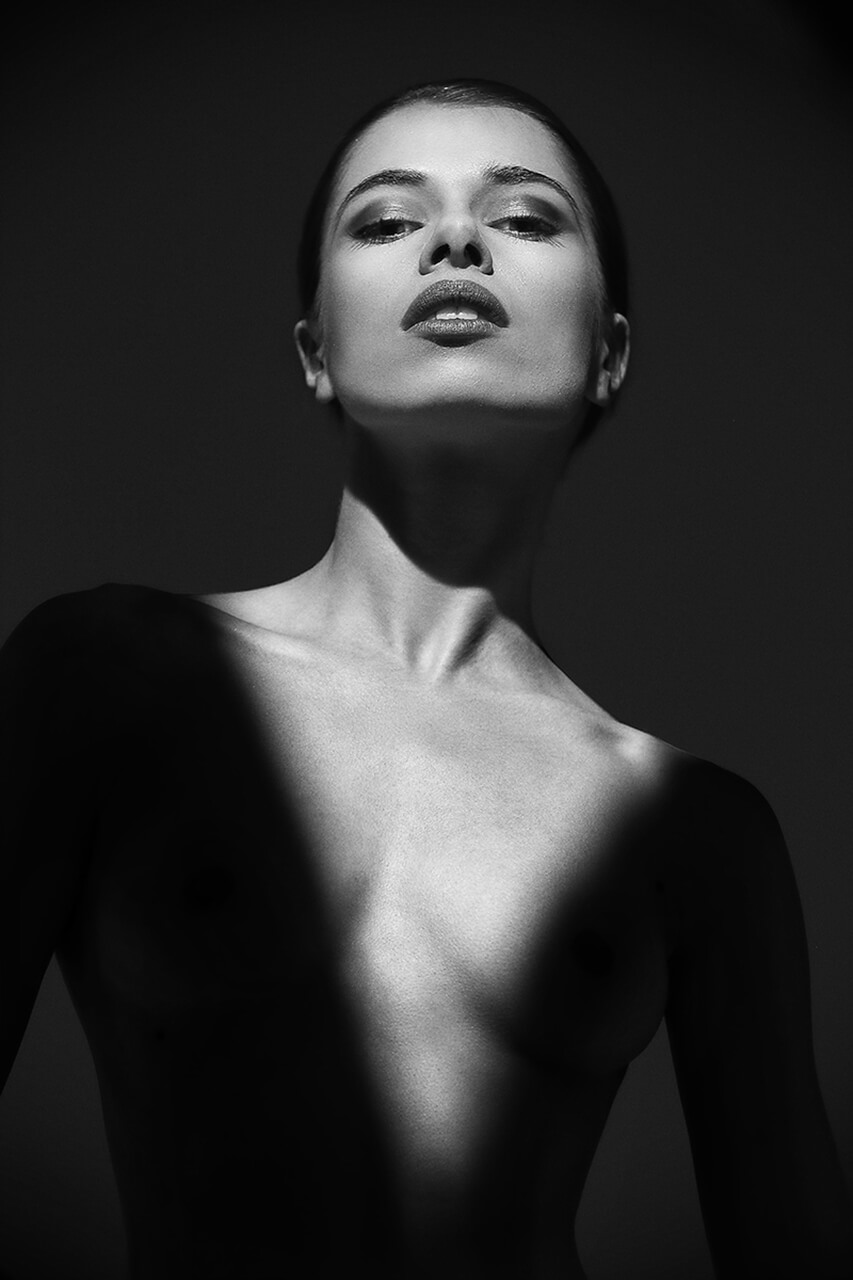
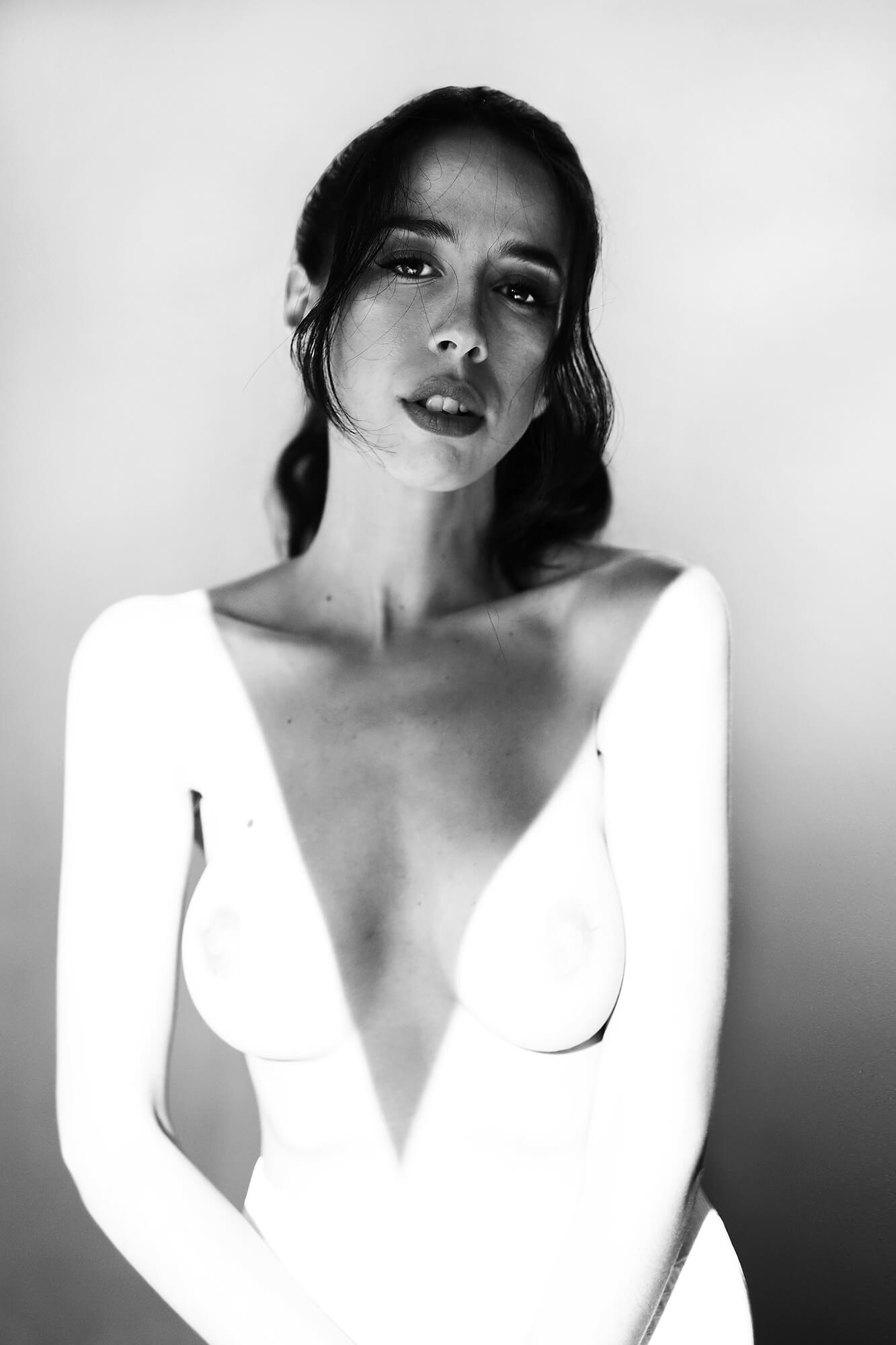
I spent a long time thinking about the technical aspect and asked myself: instead of using shadow as the element for drawing, could I use light? Just a few days later, I got to work and started experimenting. I had to know whether it was feasible and whether the resulting effect would be pleasing to the eye and visually coherent. In the photo with Chiara, everything in shadow is almost completely invisible, creating a perfectly black dress made of shadow. Meanwhile, in the photograph I now wanted to create, it would be the opposite – light was to play the role of the clothing. So I had to illuminate selected parts of the model’s body in such a way that they would become unreadable and lose their original image. Essentially, I was aiming to create a dress made of light.
The key is understanding the nature of hard and soft light
The former occurs when there is a clear and rapid transition from bright areas to shadows. Soft light has a very smooth and gentle transition from bright to shaded areas. These two basic types of light are easy to achieve. It all depends on its source – that is, how large it is and how it is positioned in relation to the model. I have noticed that in order to correct a shadow on the face that is a bit too strong or badly placed, many photographers move the lamp away from the model – as if the power of the light were the problem. Nothing could be further from the truth. Hard light is created by using a small modifier, while soft light is created by using a large one. If I have a small Stroboss without any diffuser at my disposal, I am working with a light source a few centimeters in diameter, which is very small and will generate very distinct shadows. If I put the same speedlite into a very large softbox, I will generate soft light.
Distance from the photographed subject is the most important factor
In reality, the size of the modifier depends on the distance of the light source from the subject. If I use a softbox to soften the light, I also have to place it as close to the model as possible for the light to actually be soft. If I place it 10 meters from the subject, I will not get soft light. For example, the Sun is incomparably larger than the Earth, but at the same time it is very far away from it. The result is very hard and clearly defined shadows on a sunny, cloudless day. It is different when there is fog or when the sky is overcast – then the clouds create something like a “softbox,” both muting and diffusing the sunlight.
However, let us return to our main topic, which is the process of creating the photograph. It took me quite a lot of time to synchronize everything so that it worked well. I used only one light source, as well as a little natural (ambient) light coming through the studio window. I set up a Quadralite Atlas LED continuous light and cut out a cardboard mask (gobo) that would allow me not to illuminate the face and neckline of the model’s hypothetical dress. These parts are not illuminated by the lamp – they are visible because they are lit by the light that I “let into” the room. To be honest, the model had the hardest time, as she could not move or work freely. She had to take such a position and stand still the entire time so that I could illuminate the areas I cared about most. Huge applause is due to my model for her dedication and patience!
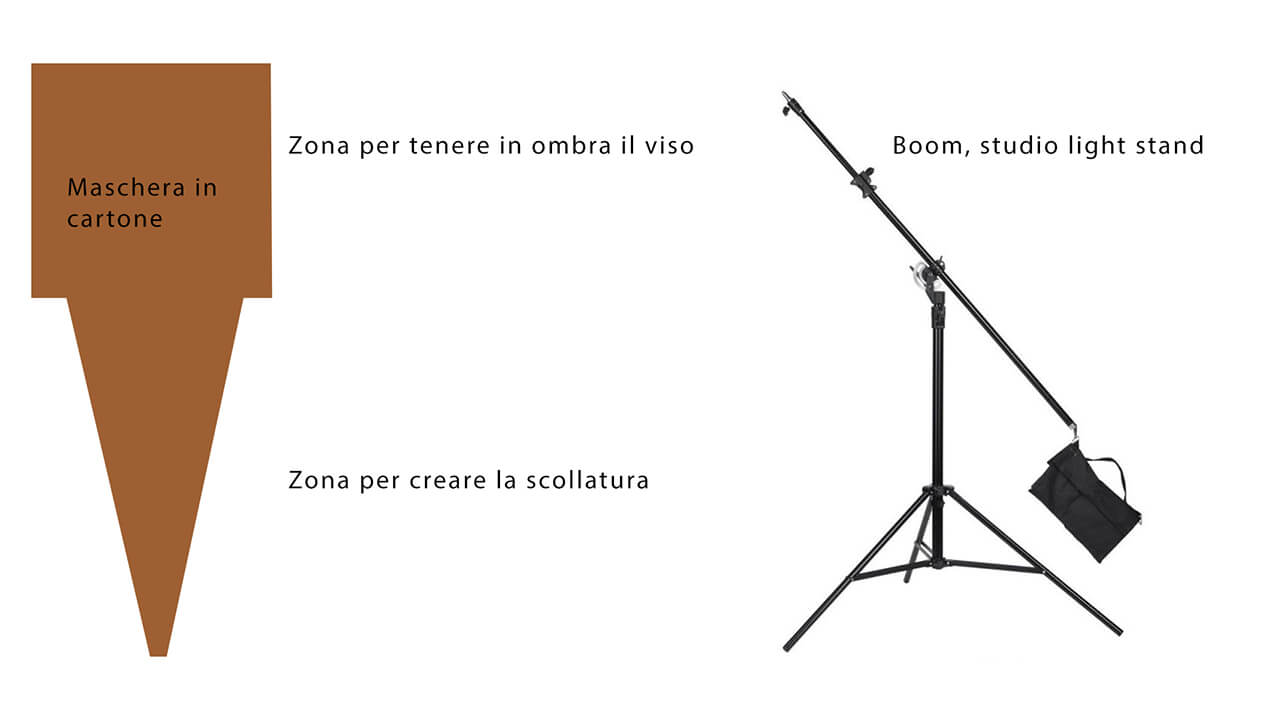
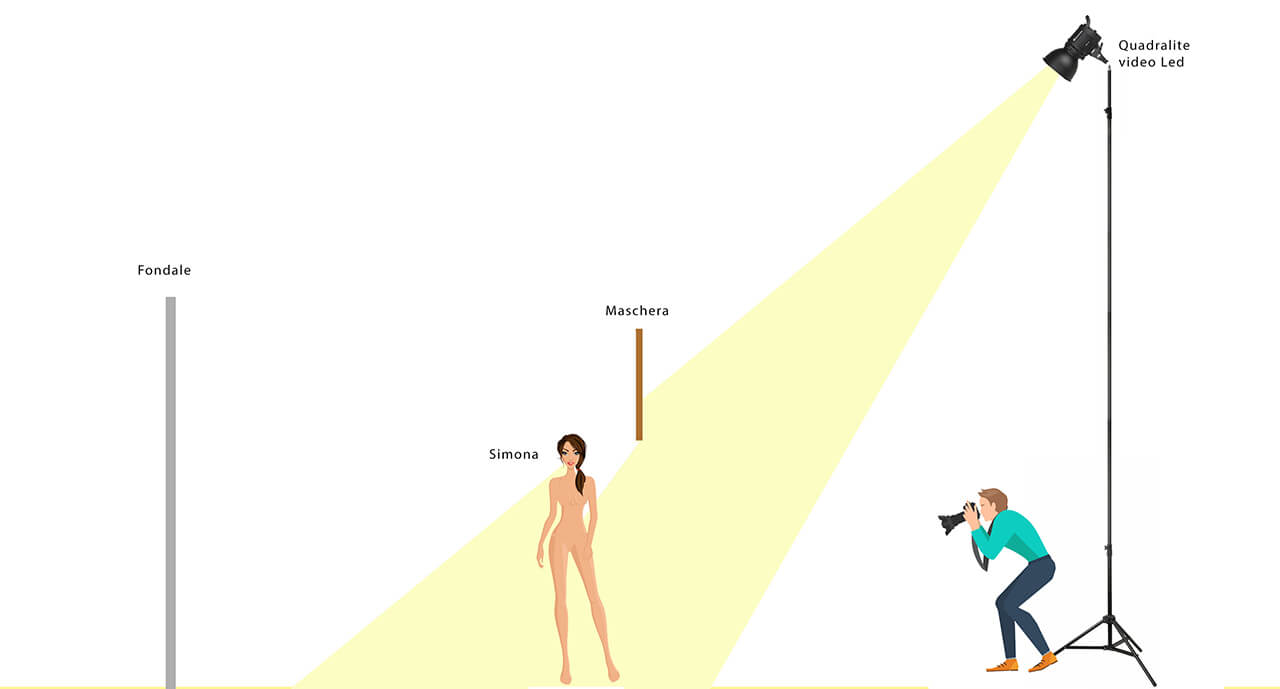
In addition to placing the LED lamp without a modifier (which was not very pleasant for the model, because of the strong light shining directly toward her), I had to deal with two other very important aspects, namely the model’s distance from the gray background and the distance of the cardboard mask from the model. It is this second distance that is extremely important, because it largely determines the precision of the transition between light and shadow. This is crucial for perceiving the skin as a kind of fabric. The transition has to be very decisive.
To achieve this, the mask or any object that casts a shadow on the body must be placed very close to the person being photographed. To check this, you only need to perform a simple test, even using a smartphone flashlight. We have a very small beam of light in the form of an LED, so we can point it at a wall and observe what happens to the shadow while waving our hand in front of it. If we place our hand close to the light source, the shadow will be large and not very sharp at the edges. If we place our hand on the wall where the light falls, the shadow will become smaller but very sharp at the edges.
I had to do exactly the same thing in the studio. I placed the cardboard mask I had made earlier close enough to the model to obtain very detailed shadows. To emphasize the illusion of a dress made of light, I also used a shallow depth of field, which, combined with the strong light, produced the effect I was looking for. The exposure was set so that the face illuminated by ambient light was slightly underexposed, while the body was strongly lit by the lamp.
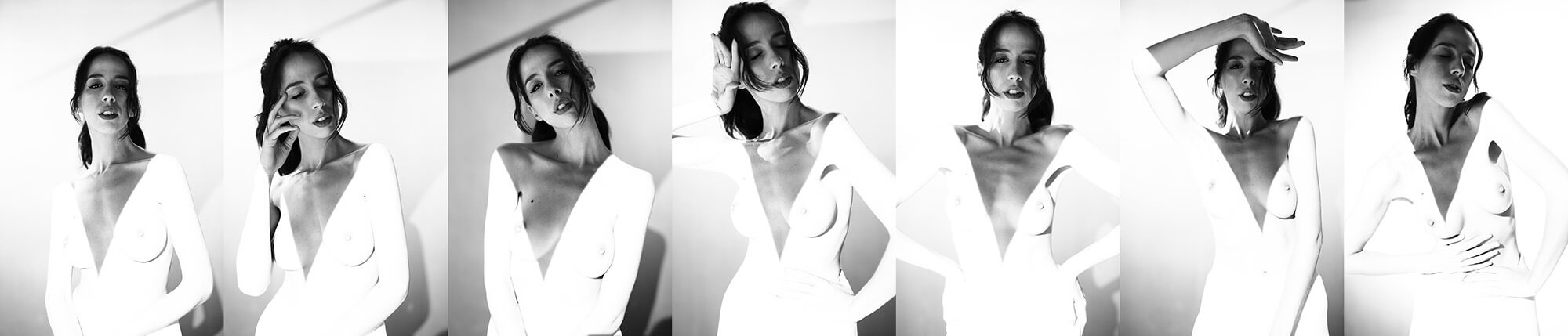
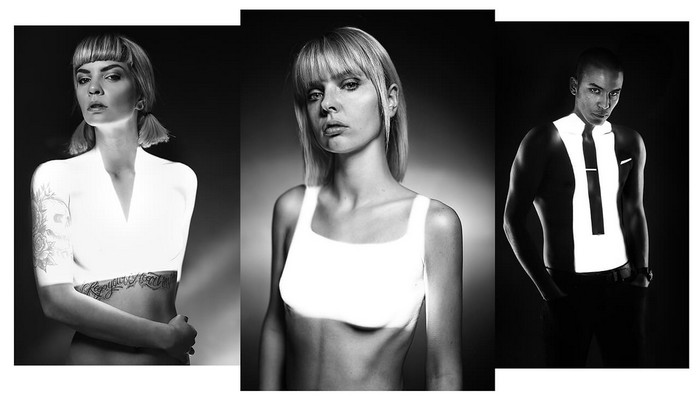
In some tests, as you can see from the series of photos above without any post-production, I tried to clear the background of shadows by using another light, but all I could achieve was an overexposed background that merged with the model’s body. I was working on correctly exposing something that was very poorly lit, so any other light source, even at low intensity, would have contaminated the scene and made the work more difficult.
The final result of my experiments is satisfying, and I am very happy with it. It is a great example of why it is worth drawing from the work of other photographers and building your own images on that basis. In this way, we practice not only our skills in working with equipment, but also have a moment to reflect on certain aspects of a conceptual nature. After all, what we perceive and how we perceive it is directly connected to the interplay of light and shadows. I do not intend to stop here and am already working on creating even more elaborate and precise creations, combining shadow and light. I encourage you to do the same!
Text and photos – Raffaele Ingegno